
German IT consulting has a business model problem. Not because demand is decreasing. But because the basic assumption on which most consulting firms have built their business is dissolving.
That assumption: complex projects need large teams.
The Body-Leasing Model
Most IT consultancies in Germany sell headcount. Whether they call it "managed services," "team augmentation," or "delivery partnerships" – at its core, revenue is a function of people times daily rate. More people, more revenue.
This model works as long as one assumption holds: that you need many specialists to build complex software. A frontend developer, a backend developer, a DevOps engineer, a tester, an architect, a Scrum Master, a product owner. Seven people for a medium-sized project.
Each person covers their specialization. The team is "thin" – remove one person and a capability gap opens.
What AI Changes
AI doesn't eliminate specializations. But it enables individuals to work across them. A strong backend developer with AI support can write respectable frontend code. A full-stack developer can set up a CI/CD pipeline. An architect can generate prototypes that used to require an implementation team.
The boundaries between roles become porous. Not because the specializations have become simpler, but because the barrier to entry for adjacent domains has dropped dramatically.
The Real Bottleneck
In most enterprise projects I've seen, the bottleneck isn't implementation capacity. It's coordination overhead. Meetings, alignments, handoffs, reviews, clarifications, status updates.
A team of seven doesn't spend seven times as many hours on the problem. It spends a significant portion of those hours coordinating. Studies show that in a team of seven, up to 40% of working time goes to communication and coordination.
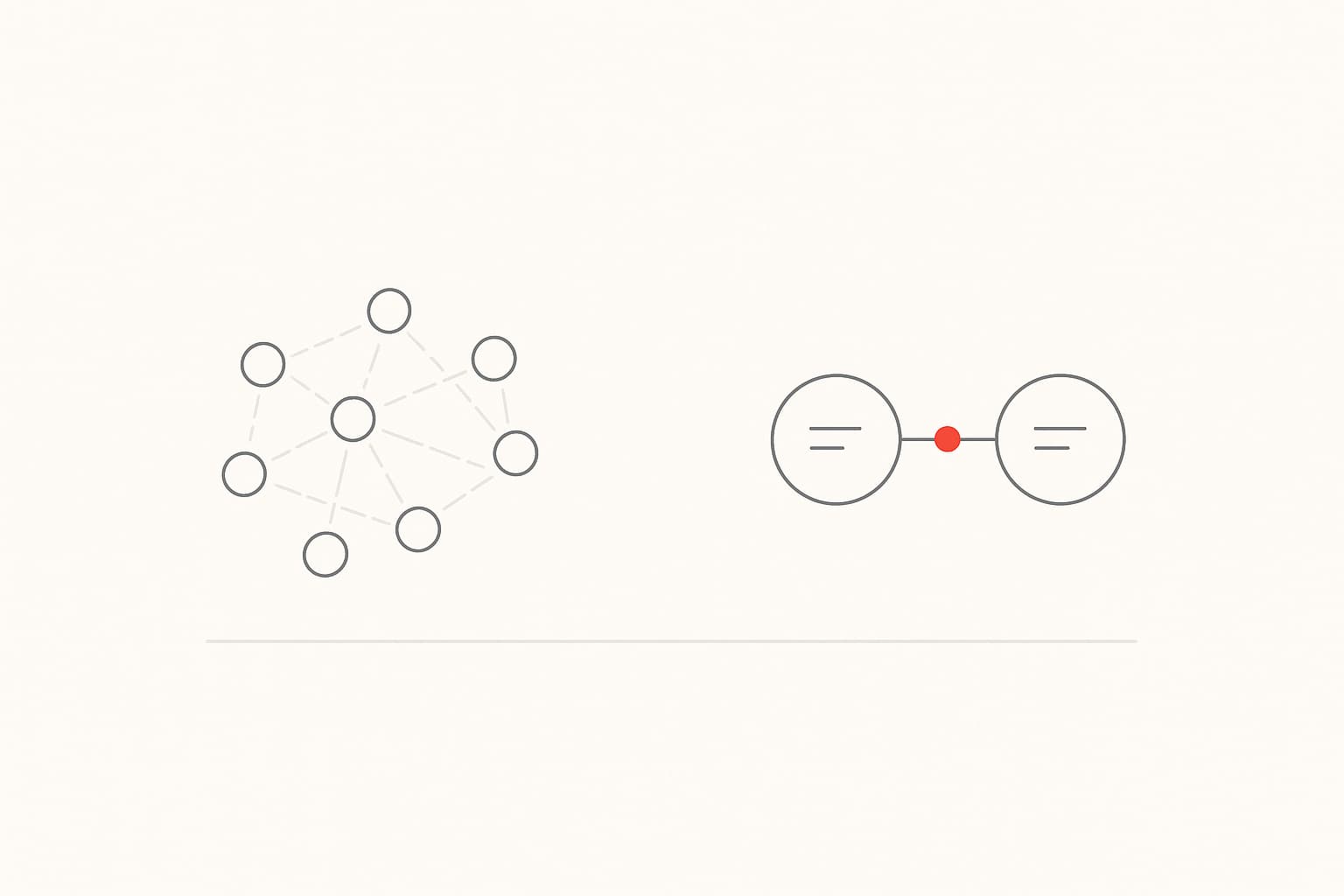
A team of two with AI support doesn't have this overhead. Two people align in five minutes over coffee. They don't need a Jira board to know what the other is doing. They don't need a Scrum ceremony to synchronize.
The competitive advantage isn't more AI. It's less coordination.
The Structural Problem of Consulting Firms
Here's the dilemma for consulting firms: If two people with AI can do what seven people did before, revenue per project drops by 70%. Even if the daily rate per person increases, the math doesn't work.
That means: firms that sell headcount will come under pressure. Not because they deliver worse. But because clients start asking the obvious question: "Why are there seven people on this project when two could handle it?"
The firms that will thrive are those that sell outcomes instead of hours. Value instead of capacity. Solved problems instead of staffed positions.
The Profile That Will Be in Demand
The consultants of the future don't look like today's. They're not pure specialists. They're not pure generalists either. They're something new:
Full-stack thinkers with domain knowledge and AI fluency.
They understand enough about frontend, backend, infrastructure, and data to see the whole picture. They know the domain well enough to ask the right questions. And they use AI not as a crutch, but as an amplifier for their existing capabilities.
These people are rare. And they'll stay rare. Because this profile isn't something you learn in a bootcamp. It takes years of experience across domains, combined with the intellectual curiosity to adopt new tools.
The Market Split
I see the market splitting into two segments:
Commodity consulting: Standard implementations, template-based solutions, well-defined scopes. This segment will shrink dramatically because AI can handle most of it directly.
Complexity navigation: Ambiguous requirements, organizational politics, regulatory constraints, architectural trade-offs. This segment will grow because AI can't navigate human complexity.
The industry won't need fewer consultants because there are fewer problems. It will need fewer because the right ones can solve more. The question isn't whether you'll be replaced by AI. It's whether you'll be replaced by someone who's better at using it.