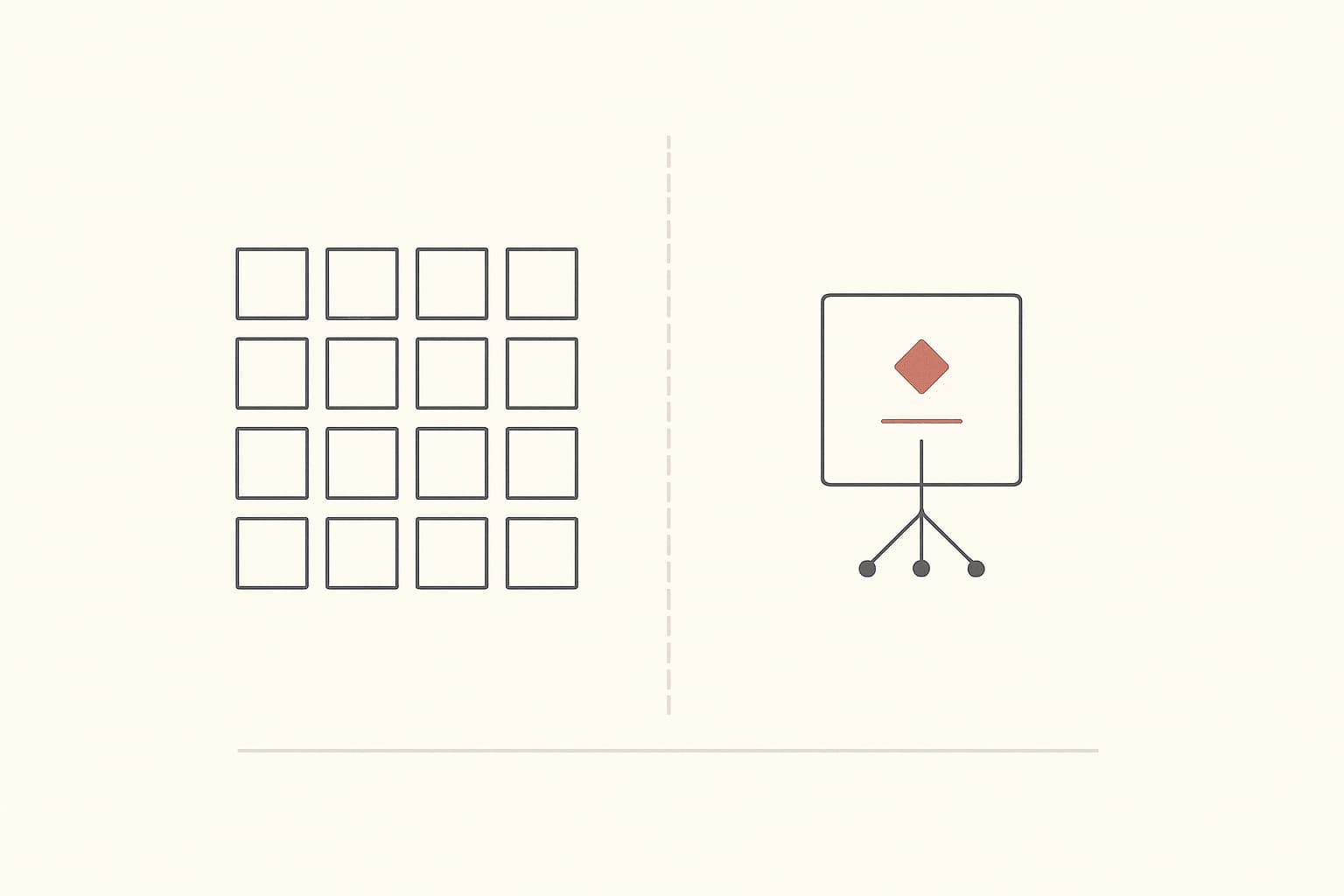

For decades, the consulting equation was simple: four developers, six months, day rate multiplied by headcount and duration. The product was not a defined outcome. It was qualified presence.
That model made sense while implementation was slow and human time was the obvious bottleneck. More scope meant more people. More urgency meant an even larger team.
AI does not make engineering free. It does, however, compress standardized implementation and allow experienced people to cover a larger part of the delivery path. That changes what a client should be paying for.
The part that does not scale through headcount
A project rarely fails because nobody could generate another endpoint. It fails because the problem was misunderstood, the architecture ignored the operational reality, an organizational dependency surfaced too late, or nobody owned the consequences of a decision.
Adding people can increase output. It cannot automatically increase coherence. Ten developers do not become one person who understands the system simply because they share a board and a daily meeting.
Judgment does not emerge from capacity. It emerges from context, experience and responsibility.
This is why smaller senior teams become more relevant as implementation accelerates. Their advantage is not that two people can magically replace ten in every situation. Their advantage is that less coordination is lost between understanding, deciding and building.
Thinking with the client is not the same as advising
Traditional consulting often separates concept and delivery. One group analyzes, another designs, a third implements. Each transition loses context and creates a place where responsibility can be handed off.
Responsible engineering keeps the decisive parts connected. It understands the business constraint, makes the technical trade-off explicit and builds enough of the critical path to prove the decision.
That requires someone who can disagree. If the requested solution solves the wrong problem, the professional response is not faster implementation. It is to make the conflict visible, propose an alternative and test the riskiest assumption.
The ability to build matters precisely because it prevents advice from remaining abstract. A decision becomes credible when it survives contact with the existing systems, data, permissions and operational constraints.
AI changes the delivery model, not the standard of care
Used well, AI shortens analysis, drafts implementations, expands tests and makes alternatives cheaper to explore. It enables a small setup to move with unusual breadth.
It does not remove the need to understand why a process exists, what must not fail, which shortcuts are unacceptable and who acts when assumptions break. Faster output makes those questions more important, not less.
The new delivery advantage is not more AI. It is less distance between context, decision and implementation.
What procurement should ask instead
The old question was: how many people do we get for the budget? A better set of questions is:
- Which concrete technical responsibility will be taken?
- Which uncertainty or critical path will be resolved first?
- How will a recommendation be proven in the real system?
- What remains with the internal team after the engagement?
- Who can explain the decision when conditions change?
These questions do not make large teams obsolete. There are programs whose volume genuinely requires them. They do expose situations where a large team is being used to compensate for unclear decisions or fragmented ownership.
A different commercial promise
A modern engineering studio should not promise unlimited capacity. It should promise clarity at a difficult point, a defensible technical decision and a critical implementation that the client's team can carry forward.
Sometimes that means working inside an existing team. Sometimes it means a bounded architecture decision or a reference implementation. The form is secondary. The constant is technical responsibility.
The difference
When implementation was the bottleneck, capacity was a reasonable product. As implementation accelerates, that product loses differentiation.
What remains valuable is the combination that cannot be assembled through staffing alone: understanding a complex system, making a decision under real constraints and being able to build the part on which that decision depends.
Capacity delivers more work. Responsible engineering makes the right work carry.